skip to main |
skip to sidebar
CMP = Rs. 162Price Target = Rs. 220Market Cap = Rs. 61,206 crHighlights:- ITC had been underperforming the market owing to fears of the implementation of the value-added tax (VAT) and a hike in the excise duty on cigarettes. Finally in this budget, the excise duty on cigarettes was increased by 5% and the hike was at the lower end of the expectations. Moreover with no change in the additional excise duty, the fear that VAT may be levied sometime in the near future has been allayed. The likelihood
that the government may allow VAT on cigarettes through a separate amendment also appears low. - Cigarettes.excise duty increased by 5%
The total excise duty on cigarettes has increased by 5% and the excise outgo currently forms 60% of the gross sales on cigarettes. In our view, ITC will effect a weighted average price hike of around 3% to pass on this tax increase to the consumer. The same, we believe, is on the lower side. It is likely that ITC will be able to maintain a 7-8% volume growth in cigarettes in FY2008. - Tax on bidis increased
It appears that the government has tried to widen the tax net on tobacco by raising excise duty from Rs 7 to Rs 11 per thousand units for non-machine made bidis and from Rs 17 to Rs 24 per thousand units for machine made bidis. The government has also imposed stringent declaration norms for bidi manufacturers producing below 20 lakh bidis. In our view, this is likely to improve the long-term volume growth prospects for the cigarette industry.
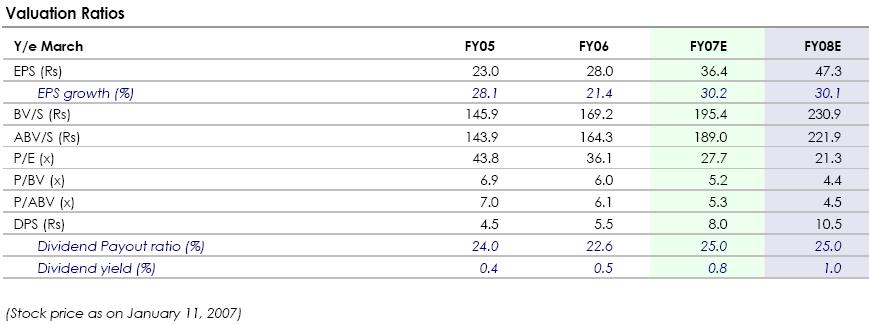
At the current market price of Rs162, the stock is attractively quoting at 18.4x its FY2008E earnings per share and 11.6x FY2008E enterprise value/earnings before interest, depreciation, tax and amortisation. - I maintain our Buy recommendation on ITC with a price target of Rs 220.
BUY: Castrol IndiaCurrent Price: Rs 233BSE Code: 500870Face Value: Rs 10- Castrol India is a 70.92% subsidiary of Castrol UK (part of BP Group), marketing the most popular lube brand in India.
- Strong growth in automobile industry and expected easing of raw material price in future should help it get back to the growth track.
- Actual EPS for year ended December 2005: Rs 11.5
- Projected EPS for year ended December 2007: Rs 15.0
- Actual EPS for year ended December 2006: Rs 11.3
Prabhudas Lilladher has reiterate their out performer rating on HDFC Bank. Currently the stock is trading at 4.5x FY 08 ABV. Net NPA of the bank remains steady at 0.4 per cent of net customer assets. 
In Q3 FY07 result, bank has reported 30.4% growth in deposits to Rs. 667.5 bn whereas advances have gone up by 33% to Rs. 480.2 bn. Within this share of retail advances have come down from 54.3% a year ago and from 56% as on Q2 07 to 52%. Steady NIM and healthy business growth has resulted in NII going up by 38.5% to Rs. 9286 mn. While true to its past performance bank has reported steady bottom line growth with net profit going up by 31. 7% to Rs. 2956 mn. CAR has improved to 12.8% against 12.1% in Q2 FY 07.
HDFC Securities Retail research recommends a “Buy on decline” on Bartronics India (BIL) with a price range of Rs 98 to Rs 111. The stock closed at Rs 123 on January 12 and trades at at 13.8 times and 8.9 times FY08 and FY09 estimated earnings.
BIL, which is the only integrated player in the AIDC/RFID solution market in India, planning to establish a manufacturing facility near Hyderabad for smart cards and/or RFID tags with an investment of Rs 262 crore.
HDFC securities expects the company to achieve a topline of Rs 71 crore, Rs 210 crore and Rs 280 crore respectively in next three years from FY07 on the back of rising output.
The new project brings with it the benefits of the first mover in a fast growing industry, faster rollout, backward integration and change in orbit for BIL. However, it exposes to the risks of project completion, gestation issues, operating risk of low utilisation in a capital-intensive industry and an entry into a commodity business.
BRICS PCG recommends a "Buy" on Infosys Technologies at Rs 2183 with a revised target of Rs 2806 (earlier target price of Rs 2217). The stock trades at 32.1 times and 25.7 times its estimated FY07 and FY08 earnings respectively.
The strong growth recorded in the December 2006 quarter with a 9.7 per cent growth in total billed volumes and a 10.1 per cent growth in revenues in dollar terms was in line with expectations.
Though the rupee appreciation led to a fall of 200 basis points in margins, it was offset to the extent of 80 basis points by an improvement in revenue productivity, 30 basis points by lower SG&A expenses and 80 basis points by higher license fees from banking product Finnacle.
Though BRICS has marginally revised its FY07 EPS estimates down to Rs 68 from Rs 69, it has kept its FY08 estimates of 85.1 unchanged. Moreover added offshore effort and continuing Client growth are key positives.
The BSE Sensex fell by 400 points in the second week of December 2006, reviving memories of the fall in May, when it crashed by more than 1,000 points within a week. The Sensex came down from a high of 13,000 to 10,000 in a month's time.
A major portion of investors' wealth was wiped out by the steep decline and many burnt their fingers, especially, those who had invested only in equities. They are yet to recover from the shock. The proverb that never put all eggs in one basket comes in handy in such times.
This axiom points at diversification of assets, since it reduces risk. Diversification here means proper asset allocation among different asset classes.
This cuts down the risk of overall negative returns, because when one asset class is performing badly, another might be doing well. What one should note is that he/she should possess negatively correlated assets, i.e. when one asset is in negative territory, other must be in positive.
As we all are aware, there is a negative correlation between the bond market and share market. When the share market witnesses a boom, bond usually does not perform well. For allocating assets to different classes, one should be aware about the various asset classes available today. Unlike the earlier days, when not many choices were available in the market, today we have a wide range of products vying for the investor's attention. For convenience sake, here we are not considering hedging tools such as futures, options, derivatives and commodities.
CashCash is the liquid form of asset with no capital growth. Inflation risk too is high. You can keep cash at your home or in savings bank account.
Fixed interest/debtNext comes fixed interest securities or debt. These could be fixed deposits with a bank or company or government or corporate bonds. Here the chances of capital growth are poor, liquidity is high. If inflation soars, real rate of return is less than the interest rate. The rate of return is around 8 per cent per annum.
Equity/sharesThe stock market is an avenue available for investors who are ready to take risks. In the long term, there are fair chances of capital appreciation. Now-a-days shares offer good liquidity too, because of the T+1 trading cycle.
That it helps you beat inflation is a great advantage. You can also diversify further by investing in various shares. The Sensex gave handsome return of 47 per cent last year and the Nifty's return stood at 40 per cent. Some shares even gave better returns than the Sensex or Nifty. But one should remember that the stock market has given negative returns twice in every seven years.
PropertyProperty is key to one's asset since a residential house is must for anybody. Some financial planners, however, do not consider residential asset as part of asset allocation strategy since you cannot sell it and go elsewhere to stay.
As we consider property from an investment point of view, it is a good avenue for investors with greater risk appetite and less concerned about liquidity. In the long run, this asset class overtakes all other categories. Property prices in all cities had appreciated by around 30 per cent last year.
Gold & JewelleryIn India, gold has been considered only for making jewellery. The yellow metal was bought and sold whenever emergency arose. Nowadays, it comes with hallmark certification - a step towards gaining more transparency. Gold is highly liquid. That last year it had given returns worth 18 per cent reinforces the fact that it a must asset.
Diamond/gemsThese are a neglected asset class in asset allocation plans. In India, they are mainly used in ornaments. At least, diamond is worth considering for investment.
Nowadays it comes with certification ensuring transparency. Though prices of diamonds have hit the roof, liquidity of this asset is a concern here. In foreign countries, people invest in diamond.
Art & antiquesLast but not the least among all the asset classes is art & antiques. These are for persons with high-risk appetite and net worth, as they require a lot of investment. You can definitely invest in works of well-known painters such as M F Hussain.
As far as capital growth is concerned, chances of appreciation are very good in the long run. There are art funds, which collect money from you and buy art & antiques. They sell it on appreciation. But the minimum investment requirement is quite high.
These are the asset classes available in the market today. But still the question remains how much to invest in each asset class. You should consult a certified financial planner before developing such a strategy.
© blogger templates 3 column | Make Money Online