HDFC Bank - Out Performer

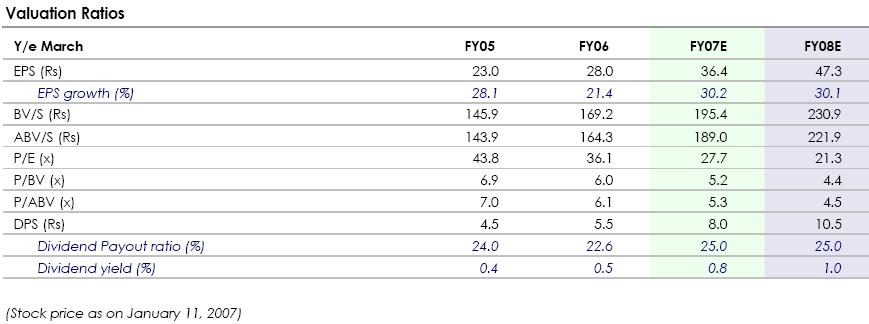
Prabhudas Lilladher has reiterate their out performer rating on HDFC Bank. Currently the stock is trading at 4.5x FY 08 ABV. Net NPA of the bank remains steady at 0.4 per cent of net customer assets.


In Q3 FY07 result, bank has reported 30.4% growth in deposits to Rs. 667.5 bn whereas advances have gone up by 33% to Rs. 480.2 bn. Within this share of retail advances have come down from 54.3% a year ago and from 56% as on Q2 07 to 52%. Steady NIM and healthy business growth has resulted in NII going up by 38.5% to Rs. 9286 mn. While true to its past performance bank has reported steady bottom line growth with net profit going up by 31. 7% to Rs. 2956 mn. CAR has improved to 12.8% against 12.1% in Q2 FY 07.

HDFC Securities Retail Research recommends Bartronics India (BIL)

HDFC Securities Retail research recommends a “Buy on decline” on Bartronics India (BIL) with a price range of Rs 98 to Rs 111. The stock closed at Rs 123 on January 12 and trades at at 13.8 times and 8.9 times FY08 and FY09 estimated earnings.

BIL, which is the only integrated player in the AIDC/RFID solution market in India, planning to establish a manufacturing facility near Hyderabad for smart cards and/or RFID tags with an investment of Rs 262 crore.

HDFC securities expects the company to achieve a topline of Rs 71 crore, Rs 210 crore and Rs 280 crore respectively in next three years from FY07 on the back of rising output.

The new project brings with it the benefits of the first mover in a fast growing industry, faster rollout, backward integration and change in orbit for BIL. However, it exposes to the risks of project completion, gestation issues, operating risk of low utilisation in a capital-intensive industry and an entry into a commodity business.

Research Calls: Infosys Technolgies

BRICS PCG recommends a "Buy" on Infosys Technologies at Rs 2183 with a revised target of Rs 2806 (earlier target price of Rs 2217). The stock trades at 32.1 times and 25.7 times its estimated FY07 and FY08 earnings respectively.

The strong growth recorded in the December 2006 quarter with a 9.7 per cent growth in total billed volumes and a 10.1 per cent growth in revenues in dollar terms was in line with expectations.

Though the rupee appreciation led to a fall of 200 basis points in margins, it was offset to the extent of 80 basis points by an improvement in revenue productivity, 30 basis points by lower SG&A expenses and 80 basis points by higher license fees from banking product Finnacle.

Though BRICS has marginally revised its FY07 EPS estimates down to Rs 68 from Rs 69, it has kept its FY08 estimates of 85.1 unchanged. Moreover added offshore effort and continuing Client growth are key positives.

How to invest in a risk-free way

The BSE Sensex fell by 400 points in the second week of December 2006, reviving memories of the fall in May, when it crashed by more than 1,000 points within a week. The Sensex came down from a high of 13,000 to 10,000 in a month's time.

A major portion of investors' wealth was wiped out by the steep decline and many burnt their fingers, especially, those who had invested only in equities. They are yet to recover from the shock. The proverb that never put all eggs in one basket comes in handy in such times.

This axiom points at diversification of assets, since it reduces risk.

Diversification here means proper asset allocation among different asset classes.
This cuts down the risk of overall negative returns, because when one asset class is performing badly, another might be doing well. What one should note is that he/she should possess negatively correlated assets, i.e. when one asset is in negative territory, other must be in positive.

As we all are aware, there is a negative correlation between the bond market and share market. When the share market witnesses a boom, bond usually does not perform well. For allocating assets to different classes, one should be aware about the various asset classes available today. Unlike the earlier days, when not many choices were available in the market, today we have a wide range of products vying for the investor's attention. For convenience sake, here we are not considering hedging tools such as futures, options, derivatives and commodities.

Cash
Cash is the liquid form of asset with no capital growth. Inflation risk too is high. You can keep cash at your home or in savings bank account.

Fixed interest/debt
Next comes fixed interest securities or debt. These could be fixed deposits with a bank or company or government or corporate bonds. Here the chances of capital growth are poor, liquidity is high. If inflation soars, real rate of return is less than the interest rate. The rate of return is around 8 per cent per annum.

Equity/shares
The stock market is an avenue available for investors who are ready to take risks. In the long term, there are fair chances of capital appreciation. Now-a-days shares offer good liquidity too, because of the T+1 trading cycle.

That it helps you beat inflation is a great advantage. You can also diversify further by investing in various shares. The Sensex gave handsome return of 47 per cent last year and the Nifty's return stood at 40 per cent. Some shares even gave better returns than the Sensex or Nifty. But one should remember that the stock market has given negative returns twice in every seven years.

Property
Property is key to one's asset since a residential house is must for anybody. Some financial planners, however, do not consider residential asset as part of asset allocation strategy since you cannot sell it and go elsewhere to stay.
As we consider property from an investment point of view, it is a good avenue for investors with greater risk appetite and less concerned about liquidity. In the long run, this asset class overtakes all other categories. Property prices in all cities had appreciated by around 30 per cent last year.

Gold & Jewellery
In India, gold has been considered only for making jewellery. The yellow metal was bought and sold whenever emergency arose. Nowadays, it comes with hallmark certification - a step towards gaining more transparency. Gold is highly liquid. That last year it had given returns worth 18 per cent reinforces the fact that it a must asset.

Diamond/gems
These are a neglected asset class in asset allocation plans. In India, they are mainly used in ornaments. At least, diamond is worth considering for investment.
Nowadays it comes with certification ensuring transparency. Though prices of diamonds have hit the roof, liquidity of this asset is a concern here. In foreign countries, people invest in diamond.

Art & antiques
Last but not the least among all the asset classes is art & antiques. These are for persons with high-risk appetite and net worth, as they require a lot of investment. You can definitely invest in works of well-known painters such as M F Hussain.

As far as capital growth is concerned, chances of appreciation are very good in the long run. There are art funds, which collect money from you and buy art & antiques. They sell it on appreciation. But the minimum investment requirement is quite high.

These are the asset classes available in the market today. But still the question remains how much to invest in each asset class. You should consult a certified financial planner before developing such a strategy.

Top Stock Picks for January 2007...

IPOs likely to net Rs 35,000 cr in 2006-07

Corporates are likely to raise around Rs 35,000 crore from the initial public offerings (IPOs) in the primary market during the current fiscal. Money raised through the IPOs during the period April-November 2006 was Rs 15,189 crore through 37 IPOs as compared to Rs 10,936 crore netted via 79 IPOs in the financial year 2005-06, a SEBI bulletin said here.

With realty giant DLF finally filing offer document for a mega Rs 13,500-crore IPO and Rs 5,260-crore Cairn India issue getting fully subscribed, the money raised through the IPOs by the corporates this fiscal is likely to be around Rs 35,000 crore with some more issue in the pipeline.

"There were 37 IPOs during the period April-November 2006 which raised Rs 15,189 crore as compared to Rs 5,890 crore raised through 41 IPOs during the same period in the previous fiscal," the SEBI bulletin issued in December said. In fiscal 2006, some mega IPOs like Reliance Petroleum and Cairn India hit the market to raise more than a billion dollar each.

While Reliance Petroleum, Tech Mahindra and Sobha Developers raised investor interest to new highs by getting oversubscribed by huge numbers, Deccan Aviation and Cairn India just managed to scrape through. Drama unfolded on the last trading day of 2006 when Nissan Copper IPO was listed on the BSE and NSE and rose by nearly 248 per cent due to alleged manipulations by the promoters as the circuit filter don't operate on the day of listing.

Among the other IPOs that raised money from primary market in the fiscal 2007 so far were Parsvnath Developers, Gwalior Chemicals, Gayatri Projects, Usher Agro, Patel Engineering, Rathi Udyog, Development Credit Bank, Blue Bird, LT Overseas, Opto Circuit and Plethico Pharma. The revival of the primary market started in 2003-04, gathered momentum in 2004-05, received overwhelming response in 2005-06 and during the first eight months of 2006-07.

Source: The Economic Times, Mumbai

Most new IPOs trade below price

If you believe in blindly investing in primary market issues, here’s some data that may make you sit up and think. Nearly 50% of the new scrips, which got listed after the May meltdown, were trading below their issue price at the close of the year.

Here’s an even bigger shocker. If you have been investing in all the initial public offers (IPOs) and follow-on public offers (FPOs) for the last three months, four out of every five stocks that you now own were trading below their listing price on the last trading day of 2006.

According to an ET study, 48% (18 out of 37) scrips that entered the market between mid-May and December 31 are trading at a discount to their offer price, while the Sensex has shot up 50% during the same period after touching a low in early June. While the volatile market post-May meltdown was said to be the reason for the poor turnout of new issues, the performance of scrips which got listed between October and December was actually worse. Fifty two per cent of them are trading below their offer price. Barring one sharp correction, the market has not witnessed a rough ride.

The real picture emerges after a close scrutiny of the data. The opening day performance of the new scrips hasn’t been too bad. Infact, just about one in five IPOs and FPOs have opened lower than their issue price. However, here’s another half of the story. As much as 70% of the scrips are trading below their list price. What’s more, in the last quarter of 2006 the performance has only become worse with 78% of scrips trading in the negative zone compared to their list price.

The list of top five underperformers include Zenith Birla, Gangotri Textiles, Rathi Udyog, Richa Knits and JHS Svendgaard. But there are some stocks which have bucked the trend. Some outperformers include Allcargo Global, GMR Infrastructure, Tech Mahindra, Voltamp, Atlanta, Action Construction, DCB, Info Edge, Parsvnath, Sobha Developers and Nissan Copper. However some of these have listed recently and it’s still early days to gauge their performance.
 

© blogger templates 3 column | Make Money Online